How doctors got real N95s in late 2020: the 500,000-unit group buys
A Wayback Machine capture dated November 5, 2020 preserves the storefront page that once lived on this domain and records a specific offer: 500,000 Honeywell N95 respirators at $3.85 each, orders due by November 23 at 9 p.m. — "EDT" in the page's own text, though daylight time had ended November 1 — shipping to begin December 14 by FedEx Ground, with refunds if the pool fell short. This article reconstructs how those group buys actually worked — from dated captures, the NIOSH Certified Equipment List, and contemporaneous price reporting — and closes with the one skill from that era a practice still needs in 2026.
The market a small practice faced in late 2020
The reason a pooled pre-order for half a million respirators made sense in November 2020 is visible in the price reporting from earlier that year. KFF Health News's morning briefing of April 17, 2020 summarized a CNN report on procurement data showing N95 respirators that had cost hospitals about $0.38 each before the pandemic being quoted at $5.75 — a roughly 1,500 percent increase — and, in the same briefing, Boston Globe reporting that 85-cent N95s were being quoted at up to $7. Those were spot-market prices for buyers with leverage. Independent and small practices generally had none: the large medical distributors were on allocation, filling hospital-system contracts first, which is the founding grievance the program at this domain stated in its own January 2021 press release (preserved in a Wayback capture of January 15, 2021).
Price was only half the problem. The other half was authenticity. CDC's National Personal Protective Technology Laboratory estimated during this period that roughly 60 percent of KN95-style respirators in the United States were counterfeit — a figure CDC published in its counterfeit-respirator guidance. A genuine NIOSH-approved N95, carrying a testing-and-certification number that anyone could look up in a federal database, was the scarce article. The group buys were engineered around exactly that scarcity.
| Price point | Per unit | Source |
|---|---|---|
| Hospital contract price, pre-pandemic | ≈ $0.38 | CNN procurement reporting, per KFF Health News, April 17, 2020 |
| Spot-market quotes, spring 2020 | $5.75 – $7.00 | CNN and Boston Globe, per KFF Health News, April 17, 2020 |
| First group buy, November 2020 | $3.85 | Wayback capture, Nov 5, 2020, of /3/n95-respirators-groupbuy/ |
| Same respirator, in stock, April 2021 | $3.36 | Wayback capture, Apr 21, 2021, of /3/aapmr/ |
Read down the table and the arc of the whole episode is already visible: the group buy undercut the spot market it was built to escape, and five months later the same respirator sat in ordinary stock at a lower price than the group buy had achieved. The mechanism worked, and then the conditions that justified it dissolved.
How the 500,000-unit buy worked
The November 5, 2020 capture lays out the mechanics plainly. The purchasing program at this domain — a group-buying collective founded by the Charleston County Medical Society, described in full in What was ActionPPE? — announced a partnership with the Wisconsin Medical Society and other participating associations to procure 500,000 Honeywell N95 respirators at $3.85 each. The structure was a conditional aggregation, closer to a crowdfunding campaign than a catalog sale:
- Pre-orders, not stock. Practices placed paid pre-orders through the WooCommerce checkout; the page stated the manufacturer order would be placed once 500,000 units had been pooled.
- A refund backstop. If the pool did not reach its goal, the capture states, orders would be refunded — the mechanism that made a pre-payment tolerable to a small practice.
- Hard deadlines. Last order November 23, 2020, at 9 p.m. ("EDT" per the page, though standard time had begun November 1); first shipments from December 14, 2020, via FedEx Ground.
- Unit economics. The respirators came in boxes of 50, listed at $192.50 per box — exactly $3.85 a unit. A December 6, 2020 capture of the same page adds a stated minimum order of two boxes, 100 units.
- A gate on who could buy. The checkout asked for a society membership number or medical license number, consistent with the program's stated restriction of sales to medical personnel for use in their practices.
One checkout detail preserves the coalition in miniature. The order form asked buyers which organization could be thanked for the purchase, and the dropdown in the November 2020 capture lists more than two dozen state and specialty bodies — from the Pennsylvania Osteopathic Medical Association and the Maryland State Medical Society to the Medical Society of the District of Columbia and the American Academy of Physical Medicine & Rehabilitation. That list, and what each society's co-branded page offered, is documented entry by entry in the partner-society registry.
The respirator at the center: TC-84A-8480
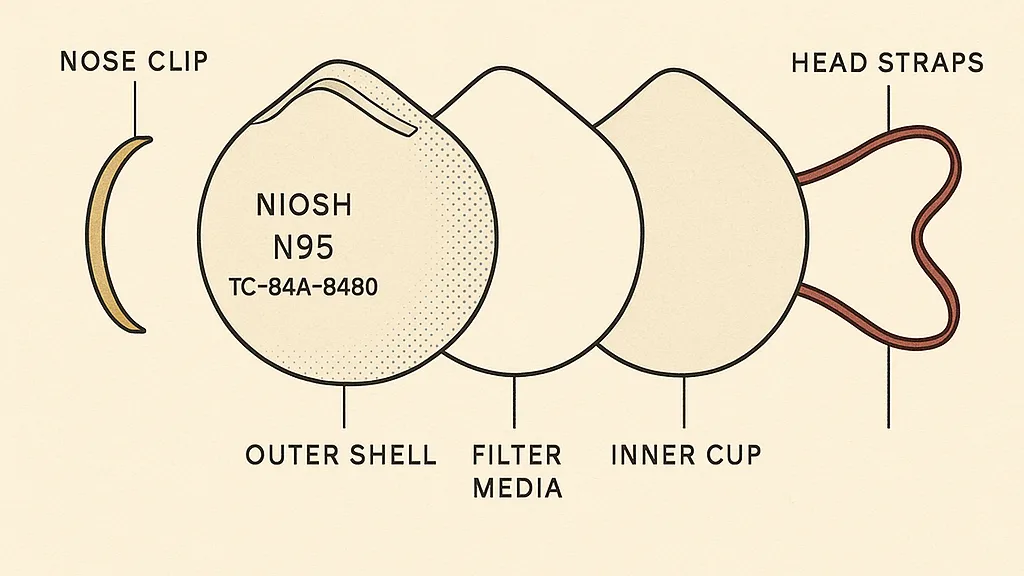
The product was the Honeywell H910 Plus, a filtering-facepiece N95 carrying NIOSH approval number TC-84A-8480. That number is the load-bearing fact of the whole episode. NIOSH issues respirator approvals under 42 CFR Part 84; the N95 designation certifies that the filter captured at least 95 percent of the NIOSH test aerosol under the regulation's test conditions. The storefront capture pointed buyers to CDC's respirator listings — an early version of the verification habit this publication treats as the era's most durable lesson.
The capture's spec block also claimed 99.9 percent bacterial and viral efficiency, a three-year shelf life from the manufacture date, one-size-fits-most sizing, and silicone- and latex-free construction. Two of those claims deserve a careful reader's asterisk. Bacterial and viral efficiency figures are manufacturer test claims, not NIOSH metrics — NIOSH approval attests to particulate filtration class under 42 CFR Part 84 and says nothing about a viral-efficiency percentage. And a shelf-life claim is a manufacturer statement too; what an expiration date actually means for a case of 2021-vintage respirators is the subject of Do N95s expire?, the direct sequel to this article.
The approval, meanwhile, has outlived the brand that sold it. Queried on NIOSH's Certified Equipment List in August 2026, TC-84A-8480 returns one active approval — schedule 84A, filtering facepiece, covering models H910 and DF300N95 — listed not under Honeywell but under PIP Global Holdings, Inc. Honeywell announced in May 2025 that it had completed the sale of its personal protective equipment business to Protective Industrial Products for $1.325 billion. The TC number stayed put while the corporate owner changed underneath it, which is precisely why verification runs on TC numbers and not brand names.
The buys, dated
- Nov 5, 2020 First capture of the group-buy page: 500,000 Honeywell H910 Plus respirators at $3.85 each; orders due November 23; shipping from December 14 via FedEx Ground; refunds if the pool falls short.
- Dec 6, 2020 The page has been rewritten in harder-selling register — a fourth-wave framing, guaranteed factory access, American manufacture — and now states a two-box (100-unit) minimum. The November 23 deadline text remains, already past.
- Jan 6, 2021 The program's press release states 3.4 million units of PPE shipped to 2,606 practices representing more than 10,000 doctors (capture of January 15, 2021).
- Jan 15, 2021 First capture of the Second Series page: a second Honeywell N95 pool, order to be placed January 25, first shipments from February 8, two-box minimum.
- Feb 2021 The Second Series deadline moves: a later capture of the same page preserves it as February 25 at midnight, while the February 8 shipping line stands unrevised beside it.
- Apr 21, 2021 Capture of the AAPM&R co-branded page: the H910 Plus sits in ordinary stock at $168 per 50-pack — $3.36 a unit, marked limited quantity — alongside a group-buy listing at the same price.
- Jun–Aug 2021 The storefront's last additions are vaccination-era supplies (June 2021) and one final partner page (August 2021). New content stops; the site freezes.
The Second Series, and what a slipping deadline shows
The second buy, at /3/n95-respirators-second-series/ as captured on January 15, 2021, reused the first buy's machinery — same respirator, same TC number, same pooled pre-order with a refund backstop, same two-box minimum — and pitched American-made Honeywell N95s at below-market prices for private practices, with the order to be placed January 25 and shipping from February 8.
Then the deadline moved. A later capture of the identical page preserves the order date as February 25 at midnight — a month's slip — while the line promising first shipments from February 8 stands uncorrected above it. The Wayback record has no intermediate capture, so the exact date of the change cannot be fixed; what the two states of the page establish is that the second pool filled more slowly than the first. That is the fade of the entire group-buy era caught in a single page edit. Vaccines were rolling out, manufacturers had scaled, and by April the same respirator was cheaper in stock than it had been in the pool. The demand emergency that made a 500,000-unit pledge drive rational was ending, and the program's own pages recorded it. Where practices turned once this whole class of ad-hoc channel wound down — this program's mid-2021 freeze, Project N95's December 2023 shutdown — is the subject of Where the pandemic PPE purchasing programs went.
What the captures cannot show
The archival record here is unusually good — dated page states, exact prices, exact deadlines — but it has edges, and they should be stated. Nothing in the Wayback record shows whether the first buy actually reached 500,000 units, when the manufacturer order was placed, or how many units the Second Series ultimately pooled. The cumulative totals that exist — 3.4 million units by January 2021, more than 5 million on mid-2021 states of the homepage — are the program's own press-release and marketing figures, self-reported and never independently audited. Capture cadence leaves gaps: the Second Series page has no preserved state between January 15, 2021 and early 2022, so the deadline extension can only be bracketed, not dated. The product's performance figures are the seller's spec-sheet claims except where NIOSH's own approval attests them. And none of this is purchasing guidance: the program described here ended in 2021, and current sourcing questions belong to the Reference wing, not the Record.
The skill that outlives the program: any TC number, into the CEL
Strip away the deadlines and the pooled orders, and the durable idea inside the 2020 group buys is a verification habit: the offer was credible because it named a TC approval number that any buyer could check against a federal database. That habit works today exactly as it did then, and it takes about a minute.
NIOSH's Certified Equipment List is the live registry of every respirator approval. Enter a TC number — TC-84A-8480, or the one printed on whatever box a distributor just delivered — and the CEL returns the approval's schedule, holder, facepiece type, covered models, and whether the approval has gone obsolete. Approvals age and get revoked; the CEL's obsolete flag is the difference between a respirator that is NIOSH-approved and one that merely was. NIOSH publication 2021-124 documents the matching physical check: an approved filtering facepiece must carry the NIOSH block, the manufacturer and model, the filter class, and the TC number printed on the respirator itself. A box that names no TC number, or one the CEL cannot find, fails the same test the 2020 group buys were built to pass. The full walkthrough — TC anatomy, required markings, counterfeit red flags — is in How to verify a respirator is really NIOSH-approved, and the short version lives on this site's N95 page.
Primary sources
- Wayback Machine captures of /3/n95-respirators-groupbuy/: November 5, 2020 and December 6, 2020.
- Wayback Machine captures of /3/n95-respirators-second-series/: January 15, 2021 and January 26, 2022 (frozen-era state preserving the February 25 deadline).
- Wayback Machine capture of /3/aapmr/, April 21, 2021 (in-stock H910 Plus at $3.36 per unit).
- Wayback Machine capture of the program's January 6, 2021 press release, January 15, 2021.
- NIOSH Certified Equipment List, query for approval TC-84A-8480, retrieved August 2026.
- NIOSH publication 2021-124, How to tell if your N95 is NIOSH Approved (required respirator markings).
- 42 CFR Part 84, Approval of Respiratory Protective Devices.
- KFF Health News morning briefing, April 17, 2020, summarizing CNN and Boston Globe price reporting.
- Honeywell press release, May 22, 2025: completion of the sale of its PPE business to Protective Industrial Products.
- CDC National Personal Protective Technology Laboratory, counterfeit-respirator guidance (the approximately 60 percent counterfeit-KN95 estimate).