Do N95s expire? What the date means and what expired stock is still good for
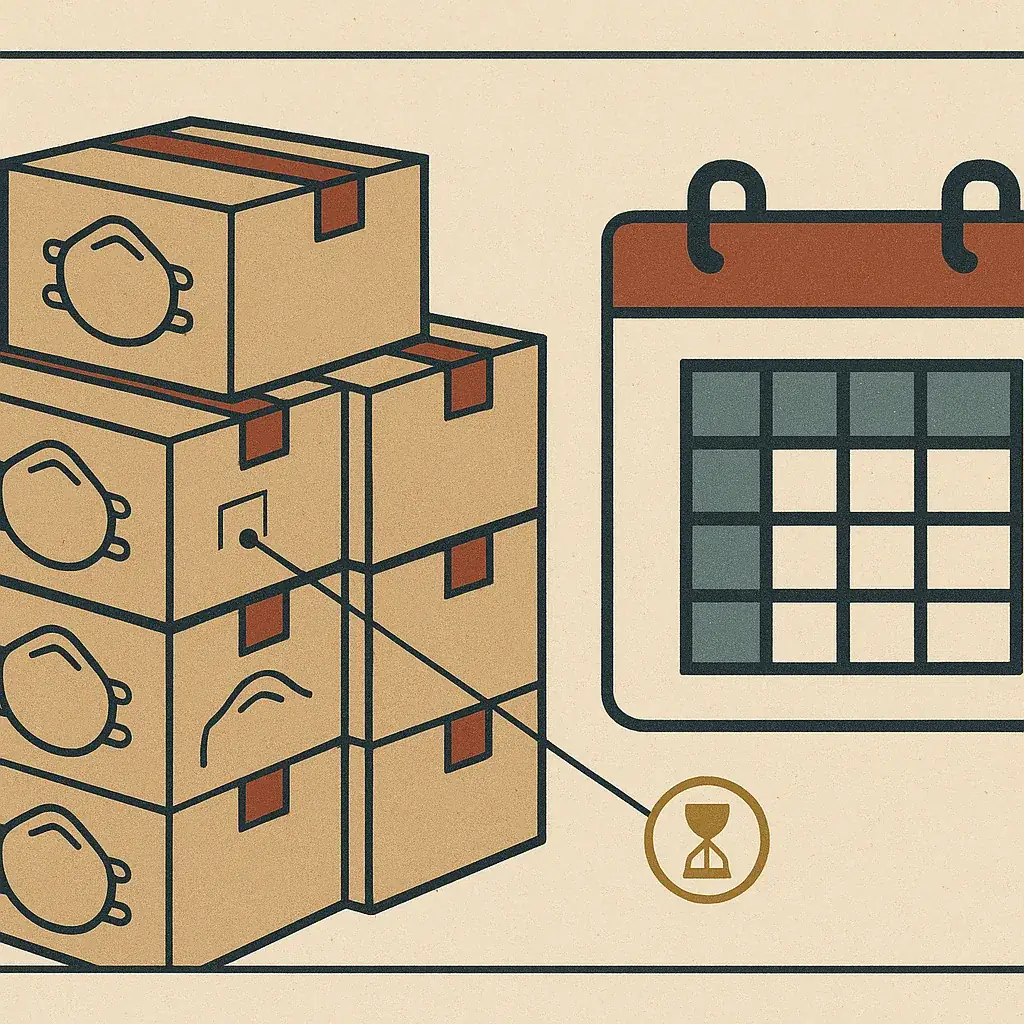
Before it was a question about the cases in a supply closet, an N95's shelf life was a line item in this domain's history: the November 2020 group buy that pooled orders for 500,000 Honeywell H910 Plus respirators — approval TC-84A-8480, shipping from December 14, 2020 — listed a shelf life of three years from the date of manufacture. Everything from that era of emergency purchasing is now years past its date. The date itself is narrower than most readers expect — a manufacturer's designation, not a NIOSH test result — but its consequence is sharp: per NIOSH's November 2025 stockpile guidance, a respirator past its designated shelf life is no longer considered NIOSH-approved, which removes it from any required-use program.
What the date on the box actually is
NIOSH approves respirators under 42 CFR Part 84, and that regulation sets performance requirements — filtration, breathing resistance — not longevity. NIOSH's aggregated stockpile report (PPE CASE P2020-0111, March 2020) states the division of labor plainly: NIOSH has no shelf-life or storage-condition requirements for particulate respirators, and the approval holder is responsible for designating a shelf life where warranted. NIOSH's November 2025 Science Bulletin on stockpiled respirator shelf life repeats the point: NIOSH does not require an expiration indicator at all. When a date appears, it is the manufacturer stating when degradation may begin.
In practice the date sits on the side or bottom of the primary box, near an hourglass icon, in YYYY-MM-DD form — the convention 3M's storage-conditions FAQ describes. Durations vary by model because components vary by model: 3M's shelf-life bulletin lists either three or five years from date of manufacture for every filtering facepiece in its line — the stockpile-standard 1860 and 1870+ carry five — while the Honeywell H910 Plus of the 2020 group buys carried three. For stock with no printed date, 3M's FAQ says its N95s should not be used once five years have passed since the manufacture date on the box. NIOSH's 2025 bulletin adds a wrinkle for reusable equipment: an elastomeric facepiece may be rated for ten years and its particulate filters for five, so one "is it expired" question can have two answers.
What "expired" means for NIOSH approval and OSHA compliance
The legal consequence is categorical, and it is the part of this question that changed after the emergency. Per NIOSH's November 2025 bulletin: a shelf life designated during the approval process becomes a condition of use, and once a respirator exceeds it, the respirator is no longer considered approved by NIOSH. OSHA's respiratory protection standard, 29 CFR 1910.134, requires NIOSH-approved respirators wherever protection is required — so an expired N95 cannot satisfy a required-use program, whatever its condition.
The pandemic years were a documented exception, created by named instruments that no longer exist. In March 2020, FDA issued an Emergency Use Authorization covering expired but undamaged, properly stored stockpile respirators; in April 2020, OSHA directed compliance officers to exercise enforcement discretion over expired-respirator use during the shortage — excluding aerosol-generating procedures on suspected or confirmed COVID-19 patients. Both allowances ended as supply recovered: OSHA's July 7, 2021 memorandum rescinded the discretion, noting FDA had revoked the related authorizations. NIOSH's 2025 bulletin states the present rule without hedging: outside a designated public health emergency, no policy exists to authorize using respirators beyond their shelf life. A 2020-era answer to this question is not a 2026 answer.
What degrades in storage — and what the stockpile studies found
An N95 is a filter and a fit, and age attacks them differently. The filtration layer in most N95s is electret media — polypropylene fibers carrying an embedded electrostatic charge that captures particles far smaller than the fiber spacing. A 2009 study in the American Journal of Infection Control (2009;37:381–386) describes the known weakness: if that charge dissipates, filtration efficiency for submicrometer particles degrades significantly, with no visible change to the mask. The fit components age more visibly, and the New Jersey PEOSH respirator FAQ and NIOSH's 2025 inspection checklist name the same suspects: straps, nose bridge, and nose foam.
| Component | How it degrades | Consequence |
|---|---|---|
| Electret filter media | Embedded electrostatic charge dissipates | Penetration rises with no visible sign; only lab testing detects it |
| Elastic straps | Harden, lose elasticity, break; staples corrode | Seal fails even if the filter still performs |
| Nose foam and nose clip | Foam crumbles or flakes; clip cracks or corrodes | Fit degrades at the highest-leak region of the face |
| Packaging | Crushing, moisture, mold, dust | Deformed facepieces; mold makes the respirator itself a hazard |
How often age actually wins is an empirical question, and NIOSH answered it at scale. From ten U.S. stockpile facilities, NIOSH researchers sampled 3,971 air-purifying respirators — twelve models manufactured between 2003 and 2013, all past any designated shelf life — and tested them against 42 CFR Part 84 performance limits. The aggregated PPE CASE report found 98% passed, and the failures clustered by lot: all 40 units of one Kimberly-Clark 46727 lot manufactured in 2007 failed, and 34 of 80 Kimberly-Clark 46827 units from two other 2007 lots — while a third 2007 lot of the same model in the same facility passed entirely. The AJIC study points the same direction: of 21 N95 models stored six to ten years, 19 still met the filtration requirement, both failures missed by under a percentage point, and failure showed no relationship to length of storage — degradation looked model- and lot-specific, not clock-driven.
Read together, the record supports two statements that sound contradictory and are not: most properly stored N95s keep filtering well past their dates — the finding behind FDA's 2020 stockpile releases — and an individual expired respirator cannot be trusted to, because the failures that do occur concentrate unpredictably in particular lots. The failing units showed no visual damage at all; NPPTL's companion test reports warn users of out-of-date respirators against exactly this false sense of confidence.
What expired stock is still good for
Expired respirators have a short but genuine list of honest uses, and the agencies name them consistently. NIOSH's 2025 bulletin: situations where a NIOSH-approved respirator is not required by an OSHA standard — training, fit testing, or personal use for source control or during episodes of unhealthy ambient air quality — provided users are told the respirators are past their shelf life. The CDPH/Cal-OSHA FAQ gave the same answer in 2020, and NIOSH's remaining options are donation, disposal, or recycling per the manufacturer's guidelines.
- Training. Donning practice, strap placement, nose-clip forming, and user seal checks consume respirators. 3M's beyond-shelf-life bulletin relays CDC's recommendation: use expired units of the same model workers wear for training, and preserve in-date stock for protection.
- Fit testing. 3M's bulletin allows it with conditions: only units stored to the packaging's specified conditions, visually inspected first — headbands, nose clip, nose foam, shell — and not long past the date; in 3M's words, fit testing with respirators more than one year beyond shelf life is unlikely to be viewed as reasonable. If pass rates dip, switch back to in-date units, and keep expired fit-test stock separated so it cannot drift into service. The test itself is covered in the fit testing guide.
The exclusions are equally specific. An expired respirator cannot serve in a required-use program under 29 CFR 1910.134 — the approval-status point above. And the CDPH/Cal-OSHA FAQ adds a caution for the dual-certified case: because NIOSH's stockpile assessment did not test fluid resistance, expired surgical N95s were not to be used for surgical procedures even when their filtration had been verified — the fluid-barrier half of a surgical N95's identity (see the mask-class comparison) went unassessed.
Storage conditions and rotation, for stock that has not expired yet
Shelf-life designations assume the storage conditions printed on the packaging; storage failures shorten them. OSHA's baseline is regulatory: 29 CFR 1910.134 requires respirators be stored away from contamination, dust, sunlight, extreme temperatures, excessive moisture, and damaging chemicals. The manufacturers add numbers — 3M's healthcare respirators carry their five-year shelf life only when stored in original packaging between −4 °F and +86 °F (−20 °C to +30 °C) at no more than 80% relative humidity, with short transport excursions accounted for.
For a practice keeping a reserve, NIOSH's 2025 bulletin frames expiry as an inventory problem: record the approval number (84A-XXXX), model, lot, manufacture date, and shelf-life date for everything stored; rotate first-in, first-out; and move stock into everyday use — or to another user of the same model — before the dates arrive. The same bulletin recommends periodically re-checking stored models against the NIOSH Certified Equipment List, because an approval can be rescinded, revoked, or go obsolete while the boxes sit — a distinct failure mode from expiry, covered in the verification article. Sizing a reserve so rotation is actually possible is its own arithmetic, covered in the burn-rate article.
What inspection cannot tell you
The evidence above has edges. The stockpile studies are model- and lot-specific: 98% is a population figure from twelve models in ten facilities, not a per-box guarantee, and NPPTL's reports say the findings may not apply to other facilities or storage conditions. And visual inspection cannot detect the failure that matters most — none of the 76 filtration failures in NIOSH's assessment showed visible damage, because charge loss is invisible by design. That asymmetry is the practical case for treating the manufacturer's date as the boundary of protective use: past it, the checks available to an office — looking, stretching straps, seal-checking — verify fit components only, and the filter is an open question. NIOSH's recommendation for genuinely ambiguous stock is to contact the approval holder with approval number, model, and lot number in hand. The approval-status rules stated here are as of August 2026.
Primary sources
- NIOSH Science Bulletin, November 20, 2025, Understanding Respirator Shelf Life — approval status at expiry, permitted uses, inspection checklist, rotation practice.
- NIOSH PPE CASE report P2020-0111 (March 2020) — 3,971 stockpiled respirators, 98% pass rate, lot-level failures; companion NPPTL test reports carry the false-sense-of-confidence caution.
- 3M Technical Bulletin, Respirators Beyond Their Shelf Life – Considerations (May 2020, Revision 3) — training and fit-testing conditions; the 2020 CDC/FDA/OSHA allowances.
- 3M Technical Bulletin, Shelf Life of Filtering Facepiece Respirators — the per-model three- and five-year table.
- 3M FAQ, Storage Conditions and Shelf Life, healthcare respirators (February 2020) — date format, temperature and humidity limits, the unmarked-stock rule.
- CDPH/Cal-OSHA FAQ, March 3, 2020 (attachment to All Facilities Letter 20-17) — expired stock for fit testing and training; the surgical fluid-resistance caveat.
- New Jersey PEOSH FAQ on fit testing and expired respirators — strap, nose bridge, and nose foam checks.
- American Journal of Infection Control 2009;37:381–386 — 21 N95 models after six to ten years of storage; the electret charge-loss mechanism.
- OSHA memorandum, July 7, 2021 — rescission of the 2020 enforcement discretion.
- Wayback Machine capture, November 5, 2020, of this domain's N95 group-buy page — the Honeywell H910 Plus listing, approval TC-84A-8480, three-year shelf life.