How much PPE should a small practice keep on hand? Burn-rate math and the 30/60/90-day question
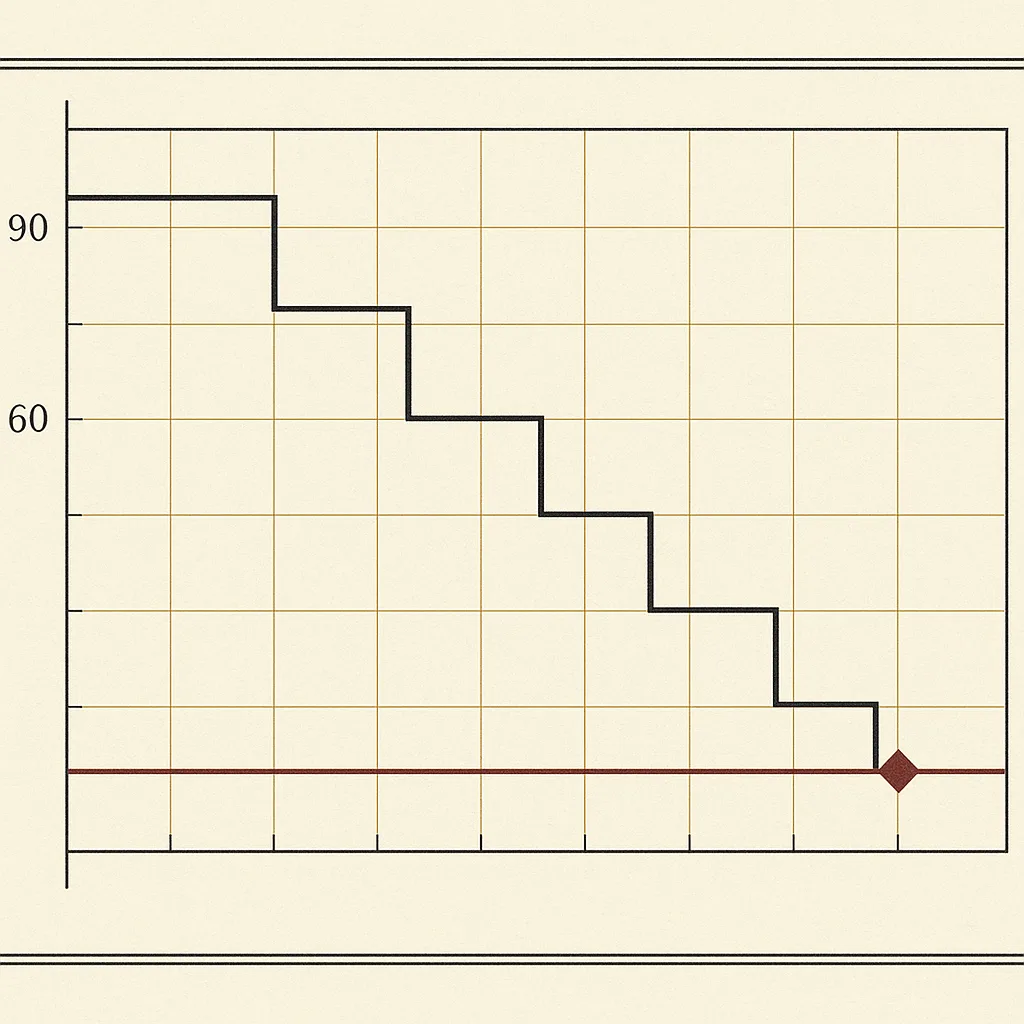
In September 2020, the group-purchasing program that then operated at this address was publishing blog posts proposing a stockpile formula for practices that could not tell when to buy. The question outlived the program: how many days of masks, respirators, gloves, and gowns should a small office actually hold? The honest starting point is that no federal rule answers it. What exists instead is worth understanding — hospital stockpile mandates in New York and California that show how regulators size a reserve when forced to name a number, and a CDC burn-rate calculator that turns the question from guesswork into arithmetic any office manager can run.
The honest answer first: no office standard exists
No federal regulation tells a physician or dental office how many days of PPE to keep. OSHA's general PPE standard, 29 CFR 1910.132, requires employers to provide suitable protective equipment where hazards call for it, and the respiratory protection standard, 29 CFR 1910.134, requires NIOSH-approved respirators wherever respirator use is required — but neither sets an inventory depth, a days-of-supply floor, or a stockpile at all. An office that runs out has a compliance problem the day a hazard goes unprotected; the day before, no inspector could cite it for a thin shelf.
The gap is not an oversight nobody has noticed. A 2025 scoping review in Preventive Medicine Reports (PMC12744811) surveyed PPE stockpile practices across 19 countries in the academic literature and 83 through WHO reports, and found wide disagreement even among national policies: Taiwan works to a 30-day requirement, Singapore and New Zealand hold three to six months, U.S. discussion of the Strategic National Stockpile has circled a 90-day goal — and one worst-case modeling recommendation put the need at 150 days, beyond most existing targets. If national governments land anywhere from 30 to 180 days, a five-person practice should not expect a settled number for its supply closet. There is none.
What a practice can do instead: see how the two states that did mandate reserves sized them, measure its own consumption with CDC's tool, and pick a target it can rotate through before the stock expires.
Where 30/60/90 comes from: the hospital mandates
The 30/60/90-day vocabulary comes almost entirely from hospital regulation written in 2020–21 — worth reading precisely, because none of it reaches an independent small practice.
New York's Department of Health amended its hospital and nursing home codes — 10 NYCRR 405.11(g) and 10 NYCRR 415.19(f), under Public Health Law § 2803 — to require, by August 31, 2021, that each hospital and nursing home hold PPE sufficient to protect health care personnel for at least 60 days, with Commissioner discretion to raise the figure to 90 during a declared public health emergency. The regulation does not leave "60 days" abstract: for hospitals it prescribes per-item formulas (15 percent, times staffed beds, times 550 for single gloves; times 41 for gowns; times 21 for surgical masks; times 9.6 for N95 respirators), and for nursing homes it keys the arithmetic to the facility's worst observed COVID-19 positivity rate. Two details carry beyond hospitals: expired products cannot be counted toward the requirement, and the regulation "strongly encourage[s]" rotating stockpiled inventory through regular usage so it never reaches its expiration date.
California legislated twice in September 2020. AB 2537, codified at Labor Code § 6403.3, required general acute care hospitals to build, by April 1, 2021, an inventory equal to three months of normal consumption across seven named categories — N95 respirators, PAPRs, elastomerics with cartridges, surgical masks, isolation gowns, eye protection, shoe coverings — with single-use stock new and unexpired, written procedures for measuring normal consumption, and civil penalties up to $25,000 per violation. SB 275 added Labor Code § 6403.1 and Health and Safety Code § 131021: a state stockpile sized to a 90-day emergency, plus a requirement that "health care employers" hold at least 45 days of surge consumption. But the statute defines health care employer as an acute care hospital, a health facility under HSC § 1250(a)(1)–(2), a medical practice operated as part of an integrated health system or facility, or a dialysis clinic — a freestanding independent practice is outside the definition.
| Who | Rule | Reserve required | Consumption basis |
|---|---|---|---|
| New York hospitals | 10 NYCRR 405.11(g) | 60 days (90 at Commissioner's discretion in an emergency) | Per-bed formulas set by the Department of Health |
| New York nursing homes | 10 NYCRR 415.19(f) | 60 days | Census × worst observed positivity rate |
| California acute care hospitals | LAB § 6403.3 (AB 2537) | 3 months | Normal consumption, measured by written procedure |
| California "health care employers" (integrated systems, dialysis) | LAB § 6403.1 (SB 275) | 45 days | Surge consumption, per state regulation |
| State of California | HSC § 131021 (SB 275) | 90-day emergency stockpile | Health care and essential workers statewide |
| Independent physician or dental offices | — | No mandate, federal or state | — |
Read as a set, the mandates agree on method even where they disagree on the number: every one of them is a multiple of measured consumption — beds, census, or metered usage — never a fixed case count. That is the transferable lesson for an office. The number that matters is not 30, 60, or 90; it is the burn rate the multiplier gets applied to.
Burn-rate math: CDC's calculator and the arithmetic inside it
The federal government's contribution to this question is a measuring tool, not a mandate. CDC's Personal Protective Equipment Burn Rate Calculator — an Excel workbook published by NIOSH, page last reviewed October 22, 2024 — was built during the pandemic for exactly this purpose and remains available. Per the CDC page, the user enters the number of full boxes of each PPE type in stock (gowns, gloves, surgical masks, respirators, face shields) and, optionally, the facility's patient count; the tool computes the average consumption rate — the burn rate — for each item and estimates how many days the remaining supply will last at that rate. NIOSH publishes the same logic as a free mobile app, the NIOSH PPE Tracker (iOS and Android), which adds restock entries and per-unit tracking.
The spreadsheet automates three lines of arithmetic that are worth seeing in the open, because they are the whole method:
- Burn rate. Count inventory on two dates. Units consumed ÷ days elapsed = units per day, per item. Counting boxes and multiplying by units-per-box is accurate enough; the calculator works in full boxes for that reason.
- Days of supply. Current inventory ÷ burn rate = days remaining at today's tempo. This is the number the 30/60/90 debate is actually about.
- Reorder point. Burn rate × supplier lead time, plus the reserve the practice has decided to keep. When inventory touches that line, reorder — the reserve is untouched buffer, not working stock.
A worked example, hypothetical throughout: an office counts 240 N95 respirators in the closet on the first of the month and 212 two weeks later. Burn rate: 28 ÷ 14 = 2 per day. Days of supply: 212 ÷ 2 = 106 days at the current tempo — but the same 212 respirators are a 21-day supply if a measles exposure or a bad influenza season pushes required use to 10 per day. Burn rate is a snapshot of a tempo, which is why New York sizes its stockpile against pandemic-condition formulas rather than quiet-season usage, and why California's SB 275 treats "surge consumption" as a distinct, regulator-defined quantity. The calculator is worth running twice: once at today's tempo, once at the worst tempo the practice considers plausible. The gap between those two answers is what a reserve is for.
Choosing a reserve target for an office
With no mandate to obey, a small practice is choosing a number, not complying with one — and the choice is a trade among three measurable constraints.
The downside being insured against. The 2020 shortage hit independent practices hardest precisely because distributors served hospital systems first — the documented condition that produced the medical-society group buys recorded in the Record. A reserve measured in days is a bridge across a delivery failure. The hospital mandates implicitly price that bridge at 45 to 90 days for facilities that cannot close; Taiwan's 30-day national floor, per the Preventive Medicine Reports review, shows a serious planner accepting a shorter bridge where resupply is trusted.
Shelf life. A reserve larger than the practice can consume before expiry is a scheduled write-off. 3M's technical bulletin on filtering facepiece shelf life puts its respirator models at three or five years, by model, from the date of manufacture under proper storage. A practice open five days a week and burning two N95s a working day consumes roughly 500 a year, so even a 90-working-day reserve (180 units at that tempo) cycles comfortably inside the window — but the same reserve for an office that uses respirators only during fit testing would expire on the shelf. The burn rate bounds the reserve that rotation can sustain.
Storage that preserves the stock. New York's regulation ties its stockpile to manufacturer storage conditions, and OSHA's 29 CFR 1910.134 requires respirators stored away from dust, sunlight, extreme temperatures, excessive moisture, and damaging chemicals. A reserve stacked beside the autoclave in a humid utility room is smaller than it looks.
The framework that follows from the sources: measure the burn rate at both tempos with CDC's calculator; hold working stock plus a reserve sized to the longest resupply failure the practice is unwilling to gamble on — the mandates above bracket the defensible range at roughly 30 to 90 days of the higher tempo — and cap the total at what will verifiably be consumed within the shelf life of the shortest-dated item. Whatever number is chosen, each restock is also a verification event: the one-minute TC-number check against the NIOSH Certified Equipment List, walked through in the verification article, belongs at every reorder, because approvals change between purchases.
Rotation against expiry
Every serious stockpile rule confronts the same failure mode: the reserve that quietly expires. New York's answer is written into the regulation itself — providers are "strongly encouraged to rotate inventory through regular usage and replace what has been used," expired products must be disposed of, and expired stock cannot be counted toward the requirement at all. California's AB 2537 and SB 275 both require stockpiled equipment to be unexpired and new. The mechanism these rules point at is first-in, first-out rotation: the reserve is not a sealed case in the basement but the back of the working shelf, drawn down from the front, restocked at the back, so every unit passes through clinical use before its date.
The arithmetic of rotation is the burn-rate math run in reverse: a reserve of R units rotates fully every R ÷ (daily burn) days, and that figure must come in under the shelf life. For the hypothetical office above — 2 respirators a working day, roughly 500 a year — a 180-unit reserve turns over in 90 working days, about 4 months, far inside 3M's three-or-five-year window. What the date on the box means, why straps and electrostatic filter media are the components that age, and the narrow honest uses left for stock past its date — training and fit-test practice — are the subject of the companion article, Do N95s expire?, the other half of this one.
What this math does not settle
Burn-rate arithmetic tells a practice how long its shelf lasts; it does not say what belongs on the shelf or when respirators are required at all — those are the province of the mask-class comparison and the OSHA respiratory protection article, and nothing here is medical or legal advice for a particular practice. The state requirements above are described as adopted; emergency regulations get amended and readopted, and a New York or California facility subject to them should read the current text rather than this summary. The evidence base is thin exactly where a small office needs it most: the 2025 scoping review found national stockpile targets diverging by a factor of six, and no study defines an optimal reserve for outpatient settings. Where the number is a judgment call, this article says so plainly.
Primary sources
- CDC/NIOSH, Personal Protective Equipment Burn Rate Calculator — the Excel tool and its instructions; page last reviewed October 22, 2024. The mobile version is the NIOSH PPE Tracker app (iOS and Android), listed among NIOSH mobile applications.
- New York State Department of Health, Hospital and Nursing Home Personal Protective Equipment (PPE) Requirements — amendments to 10 NYCRR 405.11 and 10 NYCRR 415.19 under Public Health Law § 2803; full regulatory text at regs.health.ny.gov (60-day requirement by August 31, 2021, per-item formulas, off-site storage rules, rotation and expiry provisions).
- California AB 2537 (2020), codified at Labor Code § 6403.3 — three months of normal consumption for general acute care hospitals; text at leginfo.legislature.ca.gov.
- California SB 275 (2020), codified at Labor Code § 6403.1 and Health and Safety Code § 131021 — 45 days of surge consumption for defined health care employers; 90-day state stockpile; text at leginfo.legislature.ca.gov.
- OSHA 29 CFR 1910.132 (general PPE) and 29 CFR 1910.134 (respiratory protection, including storage requirements) — osha.gov.
- PMC12744811 — Personal protective equipment stockpile practices: a document and scoping review, Preventive Medicine Reports, 2025 (19 countries in the literature, 83 via WHO reports; 30-day to 6-month national targets; 150-day worst-case recommendation).
- 3M Technical Bulletin, Shelf Life of Filtering Facepiece Respirators — three- or five-year shelf lives from date of manufacture, by model, under stated storage conditions.
- Wayback Machine captures, September 2020, of this domain's Insights blog listing, including a post proposing a stockpile formula for practices unsure when to buy — the historical grounding for the lede.