Fit testing without a hospital OH department: QLFT vs QNFT, who runs it, 2026 costs
When the group-purchasing program that operated at this domain in 2020–21 shipped its 500,000-unit N95 group buys to small practices at $3.85 a respirator, the respirator turned out to be the cheap part. A required-use N95 drags a legal apparatus behind it: OSHA's respiratory protection standard, 29 CFR 1910.134, requires every employee who must wear one to be medically evaluated, then fit tested with an OSHA-accepted protocol — per paragraph (f)(2), "prior to initial use of the respirator, whenever a different respirator facepiece (size, style, model or make) is used, and at least annually thereafter." Hospitals absorb this through occupational health departments. A five-person office assembles the same result from parts: a $19 online questionnaire, a mobile vendor, or a saccharin kit and a trained office manager. The parts are all legal. This article lays them out.
What a fit test is — and is not
OSHA defines a fit test at 1910.134(b) as "the use of a protocol to qualitatively or quantitatively evaluate the fit of a respirator on an individual." The thing being tested is not the respirator — NIOSH approval under 42 CFR Part 84 already certified the filter, as covered in the verification guide — but the junction between one specific model and size and one specific face. Paragraph (f)(1) requires testing "with the same make, model, style, and size of respirator that will be used"; a pass on a 3M 1860 regular says nothing about an 1870+, or even the 1860 in small.
Two things commonly mistaken for fit tests are not. A user seal check — the quick pressure check of Appendix B-1, done at every donning — verifies the seal that day but cannot substitute for a fit test; see below. And a medical evaluation is a separate, prior question: whether the employee can safely wear a respirator at all. The three obligations stack; none replaces another.
Whether a small office is inside the standard in the first place — required versus voluntary use under Appendix D — is answered in the small-practice OSHA guide. This article assumes the answer was yes, and everyone now needs a fit test.
The rule, and the sequence it imposes
The order of operations is fixed by the standard itself. 1910.134(e)(1) requires a medical evaluation "before the employee is fit tested or required to use the respirator in the workplace" — an OSHA letter of interpretation dated March 5, 1999 states the point in its title: medical evaluations must be performed prior to fit testing. The logic is physiological: a fit test is several minutes of breathing exercises in a sealed facepiece, exactly the exertion the evaluation screens for.
The evaluation itself is lighter than small practices often assume. Under (e)(2), it consists of the questionnaire in Sections 1 and 2, Part A of Appendix C — respiratory history, cardiac symptoms, claustrophobia, medications — reviewed confidentially by a physician or other licensed health care professional (a "PLHCP" in the standard's vocabulary). No physical examination is required unless the questionnaire answers trigger one, which is why the questionnaire-review market has moved almost entirely online, at the prices detailed below.
After medical clearance comes the fit test, using one of the protocols OSHA has accepted into Appendix A — and only those; Appendix A is captioned "Fit Testing Procedures (Mandatory)." The test recurs at least annually under (f)(2), and (f)(3) adds event-driven retests whenever anyone involved observes "changes in the employee's physical condition that could affect respirator fit" — the standard lists "facial scarring, dental changes, cosmetic surgery, or an obvious change in body weight." A model change forces a retest too: a practice that stocked one N95 model in 2021 and switched suppliers in 2024 owed everyone a new fit test regardless of the calendar.
QLFT vs QNFT
Appendix A divides the accepted protocols into two families. Qualitative fit testing (QLFT) is a pass/fail test that uses the wearer's own senses: if a test agent can be tasted or smelled inside the facepiece, the seal leaks. Quantitative fit testing (QNFT) uses an instrument to count particles inside and outside the facepiece and computes a numeric fit factor. Paragraph (f)(6) draws the boundary: "QLFT may only be used to fit test negative pressure air-purifying respirators that must achieve a fit factor of 100 or less." An N95 is a half facepiece needing exactly a fit factor of 100 — so for the respirator a small practice actually stocks, QLFT is fully sufficient. QNFT becomes mandatory only for respirators needing higher fit factors, such as full facepieces in required use, which must reach at least 500 under (f)(7).
| Protocol | Type | Test agent / instrument | Usable for an N95? |
|---|---|---|---|
| Saccharin solution aerosol | QLFT | Sweet aerosol in a test hood; nebulizer | Yes — the standard small-practice choice |
| Bitrex (denatonium benzoate) | QLFT | Bitter aerosol in a test hood; nebulizer | Yes — same procedure, bitter instead of sweet |
| Irritant smoke | QLFT | Stannic chloride smoke tube, no hood | Only with P100/HEPA filters; involuntary-response test with its own cautions |
| Isoamyl acetate ("banana oil") | QLFT | Odor detection, chamber | No — requires organic vapor cartridges, which filtering facepieces lack |
| Ambient aerosol CNC (PortaCount), original and 2019 modified | QNFT | Condensation nuclei counter, ambient particles | Yes — with a probed or adapted facepiece; pass is fit factor ≥ 100 |
| Generated aerosol; controlled negative pressure (CNP) | QNFT | Test chamber / valve-sealed facepiece | Chamber method rarely; CNP not applicable to filtering facepieces |
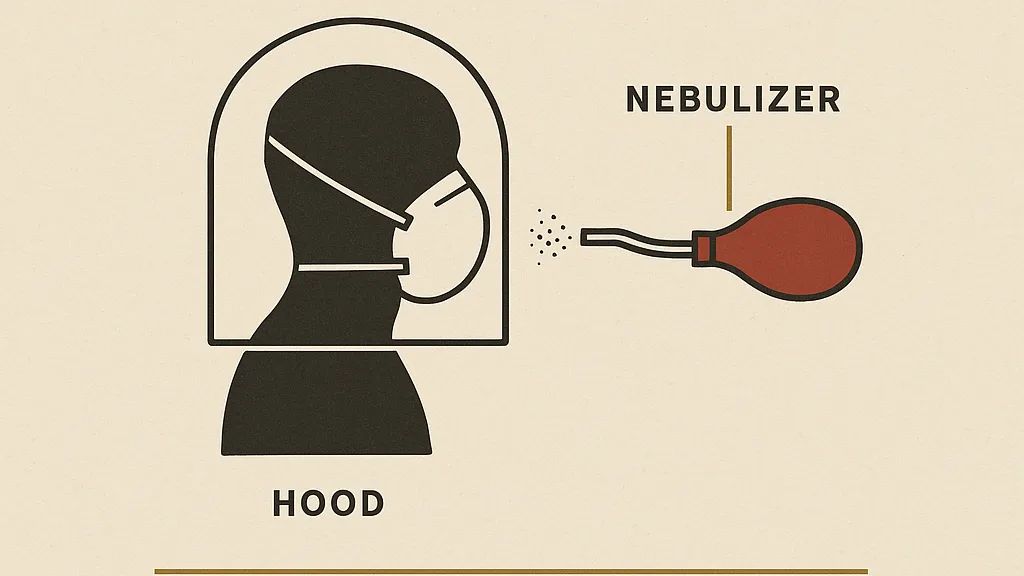
The saccharin and Bitrex protocols are what a practice without instruments will actually run, and Appendix A specifies them to the squeeze. First a threshold screen, without a respirator: the subject — no food, drink (except water), gum, or smoking for 15 minutes prior — puts on a clear hood roughly 12 by 14 inches, and dilute solution is nebulized into it in sets of ten squeezes; a subject who cannot taste the agent within 30 squeezes must be tested with the other agent, or by QNFT. Then the test proper: wearing the respirator under the hood, with full-strength solution replenished every 30 seconds, the subject performs the exercise battery — normal breathing, deep breathing, head side to side, head up and down, talking aloud, a grimace, bending over, and normal breathing once more — each for one minute except the 15-second grimace. Any detected taste is a fail, and a fail means a different size or model and starting over. The American Dental Association's guidance "Conducting Respirator Fit Tests and Seal Checks" (May 12, 2020), written for exactly this audience, budgets 15 to 20 minutes per person.
QNFT's advantage is a number instead of a taste bud. The dominant instrument is the condensation-nuclei-counter type (TSI's PortaCount is the ubiquitous example), and a Federal Register final rule of September 26, 2019 (84 FR 50739) added modified, faster CNC protocols: for filtering facepieces, four exercises — bending over (50 seconds), talking (30), head side to side (30), head up and down (39) — about two and a half minutes, versus more than seven for the original eight-exercise sequence. A half-facepiece pass remains a fit factor of at least 100. The catch is the instrument itself, priced below, which is why QNFT typically arrives in a mobile vendor's van rather than a practice's supply closet.
Who runs it when there is no OH department
OSHA requires competence, not credentials. Appendix A obliges the employer to ensure that persons administering QLFT "are able to prepare test solutions, calibrate equipment and perform tests properly, recognize invalid tests, and ensure that test equipment is in proper working order"; the parallel QNFT clause adds calculating fit factors. No license or certification is named anywhere in the standard. A trained office manager or clinical staff member who has learned the Appendix A procedure can lawfully fit-test coworkers, provided the program has the administrator that 1910.134(c) requires.
In practice, small offices assemble one of three configurations. Fully outsourced: staff visit an occupational-health clinic, or a mobile vendor visits the office — simplest, and per head the most expensive. Hybrid: medical evaluations run through an online PLHCP-review service; a vendor or clinic does only the fit tests. In-house: a QLFT kit and one person trained on the Appendix A protocol — the cheapest recurring cost, at the price of owning the procedure's correctness. The record-keeping obligation is identical in all three: (m)(2) requires retaining each current fit-test record, including the make, model, style, and size tested, until the next test supersedes it.
The ADA's fit-test guidance restates the same requirements in dental vocabulary, and notes what every fit-testing operation rediscovers: if the tested model fails on someone's face, another make, model, or size must be tried until one passes — a reason to have more than one model on hand on testing day.
What it costs in 2026
Prices below are market observations from published price lists checked in August 2026, cited to where they appear. They square with the scale the literature assumes — the UC San Diego study discussed below put fit testing's total annual cost to U.S. healthcare at $200–400 million.
Medical evaluation. Online questionnaire-review services — the Appendix C questionnaire completed on the web, reviewed by a licensed PLHCP, returning a clearance certificate — published prices of $17 to $22 per employee in 2026 (respiratortest.com's comparison lists a $19 average, against $75 to $150 at an occupational-health clinic). One mobile fit-testing vendor's price list (Kaizen Safety Solutions) puts its medical-evaluation add-on at $50 per person.
Outsourced fit testing. Published 2026 rates from occupational-health clinics and mobile vendors cluster between roughly $50 and $145 per person per test, qualitative toward the bottom of the range, quantitative toward the top. Bundles compress the paperwork: one national compliance-training firm (Compliance Solutions) lists training, online medical clearance, and a qualitative fit test together at $150 per employee across 60-plus U.S. locations. Mobile vendors commonly add travel minimums for small groups — what pushes a five-person office toward sending staff out rather than bringing a van in.
Doing QLFT in-house. A complete saccharin or Bitrex kit — hood, two nebulizers, sensitivity and test solutions — listed in August 2026 at roughly $184 (Gerson QLFT50 saccharin kit, Zoro listing) to $336–369 (3M FT-30 Bitrex kit at distributors such as Enviro Safety Products). The hood and nebulizers are reusable; only solutions are consumed. Even for a five-person office retesting annually, a kit undercuts every outsourced option within a year or two — the trade is the staff time to run it correctly.
Doing QNFT in-house. The instrument decides this one: a current-generation CNC fit tester listed at $16,784 in 2026 (TSI PortaCount 8048, Fisher Scientific catalog). For an office testing a handful of people on N95s that need only a fit factor of 100, it buys nothing QLFT does not already deliver; it is priced for institutions and vendors who test hundreds.
The annual rule and the three-year evidence
The standing rule is annual, and it is not currently in motion — but the evidence underneath it is being argued in print. A 2023 study in Infection Control & Hospital Epidemiology, "Annual N95 respirator fit-testing: an unnecessary burden on healthcare" (PMC10877532), analyzed fit-test records at UC San Diego Health: more than 12,000 healthcare workers in a survival analysis spanning 31,270 person-mask-years across five common N95 models. Of 49,290 recorded fit tests, 98.6 percent were passes; among wearers who had passed on a given model, the probability of remaining free of a fit-test failure three years later was 99.4 percent (95% CI, 99.2–99.6). The authors concluded the results "support a change in policy to reduce the fit-testing interval mandate from annual to every 3 years."
The counterweights are worth stating as plainly. The study is one health system's records, retrospective, and dominated by models its own program had already screened for fit; and the annual requirement also functions as a yearly audit of model changes, weight changes, and donning technique that no survival curve captures. There is precedent for flexing the rule under pressure — OSHA's March 14, 2020 temporary enforcement guidance suspended citation of the annual retest for healthcare during the N95 shortage while keeping initial fit tests mandatory — but that was enforcement discretion in an emergency, not a revision of the standard.
Guidance in flux — checked August 2026
The annual fit-test requirement of 29 CFR 1910.134(f)(2) remains in force as of August 2026. The three-year interval is an argument in the literature, not a rule; changing it would require OSHA rulemaking, and no such proposal is pending on OSHA's regulatory agenda as of this review. Practices planning budgets should assume annual. The live text of the standard is at osha.gov.
Facial hair and seal checks
Facial hair is the fit-test question every program eventually meets, and the rule is absolute rather than annual. 1910.134(g)(1)(i)(A) forbids tight-fitting respirators on employees who have "facial hair that comes between the sealing surface of the facepiece and the face or that interferes with valve function" — at every use, not just on fit-test day, so a beard that grows in after a clean-shaven pass voids the pass in practice. NIOSH's 2017 facial-hair infographic ("To Beard or Not To Beard?") maps which styles clear a filtering facepiece's sealing surface — most mustaches and small soul patches do; anything crossing the jaw-and-cheek seal line does not, and NIOSH's underlying research found even a day's stubble measurably increases leakage. For an employee who will not shave, the compliant options are a loose-fitting powered air-purifying respirator, which needs no fit test, or reassignment away from the exposure — an N95 over a beard satisfies nothing.
The user seal check is the fit test's daily echo. 1910.134(g)(1)(iii) requires one "each time" a tight-fitting respirator is donned, per Appendix B-1 or the manufacturer's equivalent: cover the facepiece and exhale gently, feeling slight positive pressure without edge leakage; then inhale sharply and hold, feeling the facepiece collapse and stay collapsed. Ten seconds, no equipment. The ADA guidance adds the operatory details — press the nose strip fully, inspect straps, doff without touching the exterior. The distinction to keep straight in training: the seal check confirms today's donning of a respirator that already passed a fit test; it can never stand in for the fit test itself.
Limitations
This article describes federal OSHA requirements; the roughly two dozen OSHA-approved State Plans can be stricter, so a practice in a State Plan state should check its state standard before relying on the federal text. The 2026 prices quoted are point-in-time observations from named public price lists, not a market survey, and will drift. The three-year fit-survival finding comes from a single health system and has not changed any rule. And a passed fit test measures one seal on one day under test exercises — not a guarantee of protection in use, which is why the footer's hierarchy-of-controls caveat applies to this page more than most. Nothing here is medical advice; the medical evaluation exists precisely so that a licensed professional, not an article, decides who can wear a respirator.
Primary sources
- 29 CFR 1910.134 — OSHA Respiratory Protection standard, esp. (e) (medical evaluation), (f) (fit testing), (g)(1)(i) (facial hair), (g)(1)(iii) (user seal checks), (m)(2) (fit-test records) — osha.gov.
- Appendix A to 29 CFR 1910.134 — Fit Testing Procedures (Mandatory): saccharin, Bitrex, irritant smoke, isoamyl acetate QLFT protocols; ambient aerosol CNC, generated aerosol, and CNP QNFT protocols; administrator-competence clauses — osha.gov.
- Appendices B-1 (User Seal Check Procedures), C (Medical Evaluation Questionnaire), and D (voluntary use) to 29 CFR 1910.134.
- OSHA letter of interpretation, March 5, 1999 — "Medical evaluations must be performed prior to fit testing" — osha.gov.
- OSHA final rule, "Additional Ambient Aerosol CNC Quantitative Fit Testing Protocols," 84 FR 50739, September 26, 2019 — federalregister.gov.
- "Annual N95 respirator fit-testing: an unnecessary burden on healthcare," Infection Control & Hospital Epidemiology, 2023 — PMC10877532.
- American Dental Association, "Conducting Respirator Fit Tests and Seal Checks," May 12, 2020 — ada.org (PDF).
- NIOSH, "To Beard or Not To Beard? That's a good Question!" facial-hair infographic and blog post, November 2017 — CDC/NIOSH Science Blog.
- OSHA memorandum, "Temporary Enforcement Guidance — Healthcare Respiratory Protection Annual Fit-Testing for N95 Filtering Facepieces During the COVID-19 Outbreak," March 14, 2020 — osha.gov.
- 2026 price observations, all checked August 2026: respiratortest.com cost comparison (online evaluations $17–22, clinics $75–150); Kaizen Safety Solutions ($50 medical evaluation); Compliance Solutions package ($150/employee); Zoro, Gerson QLFT50 kit ($183.99); Enviro Safety Products, 3M FT-30 kit ($335.89); Fisher Scientific, TSI PortaCount 8048 ($16,784.25).