Where the pandemic PPE purchasing programs went — and how practices source PPE in 2026
Every channel built to get PPE to independent practices during the shortage is now gone. The medical-society group buys — including the one that operated at this web address — stopped adding products in mid-2021. Get Us PPE, the donation clearinghouse, stopped fundraising that July. Project N95, the nonprofit marketplace that outlasted them all, closed its shop in December 2023 after moving more than 37 million units. A practice manager who bookmarked any of those links in 2021 now finds a dead page — and the question that sent doctors to those channels in the first place, who can be trusted to sell authentic PPE, did not close with them. This article records where each channel went, and where its function lives now.
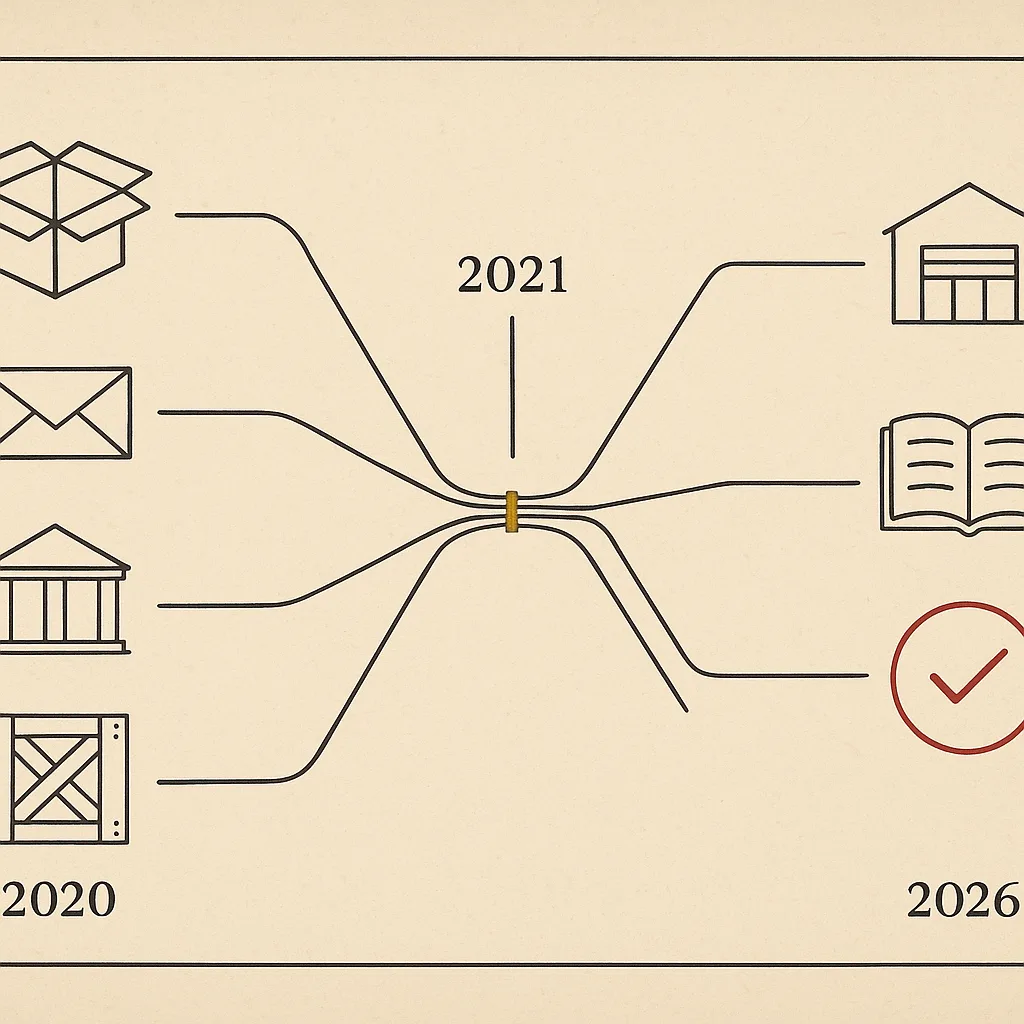
The emergency channels of 2020–2021
The ad-hoc purchasing programs existed because the normal channel failed selectively. When demand spiked in the spring of 2020 — a Premier survey of nearly 1,600 hospitals that April found they needed roughly seventeen times their usual N95 supply — the large medical distributors put products on allocation and served their biggest contracts first. Supply Chain Dive's February 2021 reporting on what it called the "haves and have nots" documented the result: Trinity Health was holding 120 days of stock for most items and Indiana University Health a six-month reserve, while requests to the donation clearinghouse Get Us PPE surged 260 percent between November and December 2020, and 86 percent of the facilities reporting N95 shortages to it in January 2021 reported unsafe usage rates. The same reporting put peak spot-market N95 prices around $7 per respirator, against pre-pandemic costs of 11 to 38 cents.
Independent practices — too small for allocation priority, too exposed to shut down — got their PPE through four improvised channels:
- Medical-society group buys. County and state medical societies aggregated members' orders for volume pricing. The program at this address, founded by the Charleston County Medical Society in March 2020, grew to more than 40 participating state and national associations and reported more than 5 million units shipped by mid-2021, per dated Wayback Machine captures of its homepage. Its largest single mechanism was a 500,000-unit N95 group buy in November 2020, recorded in a separate article of this Record.
- Nonprofit vetted marketplaces. Project N95, founded in March 2020, vetted manufacturers and checked products before listing them — a service that mattered because the grey market was saturated with fakes. CDC's National Personal Protective Technology Laboratory estimated at the peak that roughly 60 percent of KN95 respirators in the United States were counterfeit.
- Donation clearinghouses. Get Us PPE matched donated equipment to facilities using an allocation algorithm weighted by facility type and exposure risk, per Supply Chain Dive's account of its Fair Distribution system.
- The spot market. Brokers and third-party marketplace sellers, at the $7-per-N95 prices above, with no reliable authenticity checking. This was the channel the other three existed to protect practices from.
It is worth recording why medical societies, of all institutions, ended up running storefronts. They held the two assets the emergency actually demanded: a membership list that reached exactly the practices the distributors were skipping, and standing trust with those practices at the precise moment CDC was estimating that a majority of one whole product category on the open market was counterfeit. The checkout pages captured from the program at this address asked buyers to name the participating organization to credit for their purchase — a dropdown listing more than two dozen societies — because the model's whole engine was affiliation. A cold website selling KN95s in 2020 was indistinguishable from a counterfeiter; a county medical society emailing its own members was not. That trust asset is also why the model could not outlive the emergency: a society lends its name against a crisis, not as a permanent retail brand.
The mid-2021 freeze
None of the society programs published a shutdown notice. What the archival record shows instead is a freeze: as vaccination replaced barrier protection as the urgent clinical task in mid-2021, the programs simply stopped moving. Dated Wayback Machine captures of the program at this address trace the pattern, and it is representative of the model:
- Nov 2020 – Feb 2021 Peak of the society model: the 500,000-unit N95 group buy and its Second Series run back to back, per captures of the group-buy pages.
- Apr–Jun 2021 Homepage captures report "more than 5 million units" shipped; the storefront's last new products, added in June 2021, are vaccination supplies — syringes and needles, not barrier PPE.
- Jul 2021 Get Us PPE ceases fundraising on July 2, 2021, per its own published FAQ, and later winds down PPE operations.
- Aug 2021 The last new society storefront page appears in the capture record (the Arkansas program page). No new content follows.
- 2022–2023 The frozen storefront sits online essentially unchanged; a November 2022 homepage capture still carries the mid-2021 unit count.
- Feb 2024 Storefront pages still technically resolve in captures; the domain subsequently lapsed and left the program's operators entirely.
The freeze had a plain economic logic. The group buys existed to concentrate scattered small orders into volumes a factory would prioritize during a shortage. Once distributors came off allocation and prices fell back toward normal, a society storefront charging near-market prices for the same products a distributor now stocked had no function left — and no one needed to announce that for it to be true.
Project N95, the last intermediary
Project N95 outlived the society programs by two and a half years, because its product was never really aggregation — it was trust. The organization ran what The Sick Times' December 2023 report called an extensive vetting process on the masks it sold, and, in that report's words, "became a trusted source." Its own wind-down notice states the totals: more than 37 million units of PPE distributed through its shop, and more than 5 million items donated to frontline and essential workers.
The end came on the revenue side. The organization's November 20, 2023 announcement cited "a precipitous drop off of sales of masks and dwindling donations"; its wind-down page states that shop proceeds and donor contributions were no longer sufficient to support the charitable mission. The shop stopped selling in mid-December 2023 — the announcement set December 15 as the last purchase day, The Sick Times reported December 17, and the University of Nebraska Medical Center's Transmission newsletter (December 5, 2023) reported December 18 — with hardship requests accepted through December 20. The UNMC piece ran under the headline "Two N95 Companies Shut Down, as an Era Ends," which is the accurate summary: Project N95 was the last general-purpose intermediary whose whole job was standing between healthcare buyers and counterfeit PPE. What remained after the closure, per the wind-down page, was a static guide pointing to previously vetted products at third-party retailers.
The instructive detail for 2026 is why it failed: not scandal, not supply, but the same demand collapse that froze the society programs in 2021, arriving on a delay. When buyers stopped feeling at risk, they stopped paying the small premium that independent vetting cost — and the vetting infrastructure dissolved.
What happened to the domestic manufacturers
The purchasing programs' disappearance was half of the story; the supply side ran the same arc. The federal government invested over $1 billion in 2020 to build domestic PPE manufacturing, and dozens of American mask and glove startups launched into the shortage. Healthcare Brew's August 2025 retrospective found that those companies have mostly shut down, undercut on price as imports rebounded; the American Medical Manufacturers Association's executive director, quoted in that reporting, put it plainly — many of the companies that stood up during Covid disappeared because they were "just undercut overnight." The American Hospital Association calculated that the U.S. imported over $75 billion in medical devices and supplies in 2024 alone, and hospital purchasing has broadly returned to cost-driven, just-in-time models rather than pandemic-era stockpiling.
For a small practice the practical consequence is that the 2026 supply chain looks structurally like the 2019 one: import-dependent, price-optimized, and thin. The channels that improvised around its failure were not replaced with sturdier ones; they were dismantled when the emergency ended. What a practice controls is its own reserve — the arithmetic of which is covered in the stock-planning article of The Reference.
How a practice sources PPE in 2026
Each emergency channel's function still exists — it just moved. The table maps where.
| 2020–2021 channel | What it actually provided | Where that function lives in 2026 |
|---|---|---|
| Medical-society group buys | Order aggregation for volume pricing and factory priority | Group purchasing organizations (GPOs) and society-endorsed supply programs; standard distributor accounts, now off allocation |
| Project N95's vetting | Authenticity checking between buyer and seller | Self-verification: the TC number checked against the NIOSH Certified Equipment List, markings checked against NIOSH publication 2025-105 |
| Get Us PPE's clearinghouse | Emergency allocation when purchasing failed | No general replacement; state stockpile programs vary — a practice's own reserve is the dependable layer |
| Spot-market brokers | Volume at any price, authenticity unverified | Still exists on third-party marketplaces; NIOSH guidance recommends authorized distributors instead |
Two of those rows deserve a plainer translation. First, the group-purchasing function: a GPO negotiates contract pricing with distributors and manufacturers on behalf of its members, which is what the society storefronts were improvising by hand in 2020. Many state medical and dental associations now route members to an endorsed GPO or purchasing partner instead of operating anything themselves — the affiliation survives, the storefront does not. A small practice that wants 2020's volume pricing without 2020's improvisation joins one through its association or its distributor, and the ordinary distributor account does the rest, because nothing is on allocation in a normal year.
Second, the reserve function. New York and California now require their hospitals to hold PPE reserves — built on 60- and 90-day constructs respectively — but no federal or state rule sets an equivalent for medical and dental offices, a gap the stock-planning article works through with CDC's burn-rate calculator. The practical point for sourcing is timing: the practice that buys on a schedule, rotating stock ahead of its shelf life (what the expiration date means), never has to buy in the market conditions this article's first section describes.
The vetting that Project N95 performed as a service is now a workflow any practice can run itself, because the primary tools are public:
- Verify the product, not the listing. Every NIOSH-approved respirator carries an approval number — for example TC-84A-8480, the Honeywell model the 2020 group buys carried — issued under 42 CFR Part 84 and searchable in NIOSH's Certified Equipment List. The CEL search accepts a TC number, a manufacturer, or a protection class, and flags approvals that have gone obsolete. A model that cannot be found there is not NIOSH-approved, whatever the box says. The full walkthrough is in the verification guide.
- Verify the seller. NIOSH publication 2025-105, Informing Workers of Counterfeit and Misrepresented Respirators (issued June 2025, revised January 2026), recommends purchasing respirators, filters, and cartridges from authorized distributors rather than third-party marketplaces or unfamiliar websites. Major respirator manufacturers publish their authorized-distributor lists; a seller absent from them is the modern spot market.
- Read the markings. The same NIOSH fact sheet lists the red flags: no markings on the facepiece, no TC approval number on the respirator or headband, and claims no NIOSH approval can make — such as approval for children.
- Treat surgical claims as a separate check. A surgical mask is an FDA class II device under 21 CFR 878.4040; "FDA-registered" or "FDA facility" language on a listing is not a clearance. The distinctions are laid out in the mask-comparison article.
- Let price be a signal in both directions. The 2020 record shows what panic pricing looks like ($7 for an 11-to-38-cent respirator, per Supply Chain Dive); CDC's counterfeit estimates show what too-cheap bought. A reserve sized by burn-rate math is what keeps a practice out of both ends of that market.
Guidance in flux — checked August 2026
The 2025 restructuring of federal health agencies reached NIOSH itself: positions supporting the Respirator Approval Program were cut in early 2025 and subsequently reinstated, and a proposal to fold NIOSH into a new National Center for Chemicals and Toxins remains pending for FY2027. Through all of it the approval program has continued operating and the Certified Equipment List has remained live; a dated status section is maintained in the verification guide.
What this record can and cannot say
The account of the society-model wind-down rests on dated Wayback Machine captures, and captures are samples, not surveillance: a page's last capture bounds when it changed, not exactly when. No formal shutdown notice from the program formerly at this address — or from most of its peer programs — has been found in the archival record, so the freeze chronology above is an inference from what stopped appearing, stated as such. Project N95's closure, by contrast, is documented in its own words. On the 2026 side, the sourcing workflow above describes verification mechanics, not medical selection: which respirator a given practice needs for a given exposure is a respiratory-protection-program question under 29 CFR 1910.134, covered in the small-practice OSHA article, and contemporaneous sources disagree by a few days on Project N95's exact final sales date, as noted above.
Primary sources
- Project N95, "Winding Down" — the organization's own closure notice (projectn95.org/winding-down): 37+ million units distributed, 5+ million donated, insufficient proceeds cited.
- Project N95 wind-down announcement, November 20, 2023 (via EIN Presswire): discount window, December 15 last purchase day, "precipitous drop off of sales" language.
- The Sick Times, "Project N95 ending mask store, free distributions by the end of 2023," December 5, 2023.
- University of Nebraska Medical Center, The Transmission, "Two N95 Companies Shut Down, as an Era Ends," December 5, 2023.
- Supply Chain Dive, "The PPE supply chain is a case of the 'haves' and the 'have nots'," February 11, 2021: allocation disparities, Get Us PPE request surges, spot prices.
- Healthcare Brew, "Despite Covid-19 pandemic efforts, the US still mostly imports PPE," August 12, 2025: $1B+ federal investment, AHA $75B 2024 import figure, Premier April 2020 survey.
- NIOSH publication 2025-105, Informing Workers of Counterfeit and Misrepresented Respirators (June 2025, revised January 2026).
- NIOSH Certified Equipment List, wwwn.cdc.gov/niosh-cel — the live approval database.
- Get Us PPE, published FAQ: fundraising ceased July 2, 2021; operations wound down.
- Dated Wayback Machine captures of this domain, 2020–2024: homepage unit counts (April–June 2021, November 2022), June 2021 vaccination-supply additions, August 2021 final partner page, February 2024 last resolving storefront captures.