N95 vs KN95 vs surgical mask: what a healthcare practice is actually required to use
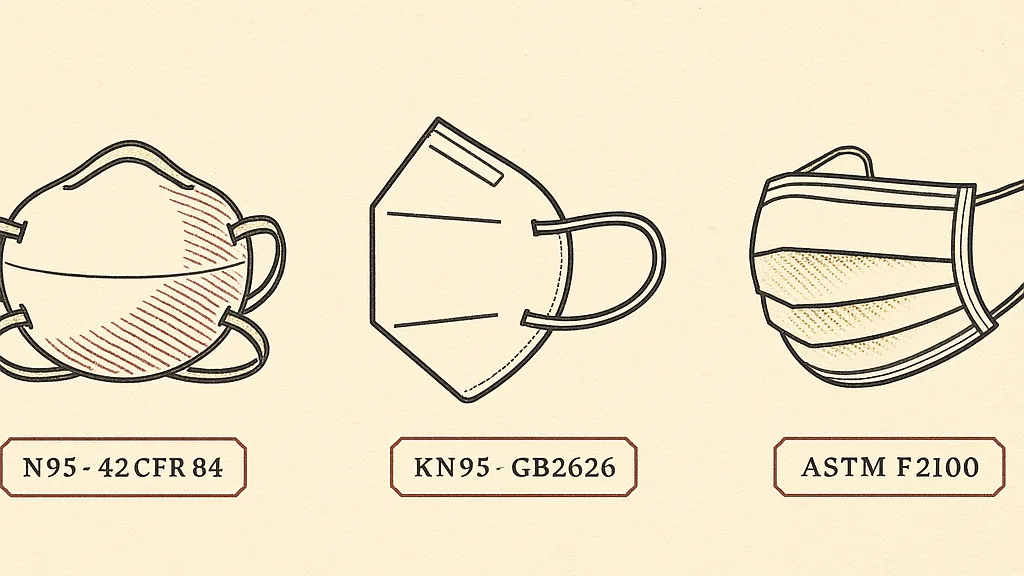
In November 2020, the group-purchasing program that then operated at this domain listed KN95s certified to China's GB 2626 standard and, a page away, ran group buys of NIOSH-approved Honeywell H910 Plus N95s under approval number TC-84A-8480 — two products that look nearly identical on a shelf and occupy entirely different legal categories. That difference did not fade with the emergency. Under OSHA's respiratory protection standard, 29 CFR 1910.134, exactly one of the three products in this article's title can serve where a practice is required to protect employees from an airborne hazard. The other two have jobs of their own, but that job is not respiratory protection under U.S. law.
Three products, three jobs
The clearest official taxonomy comes from FDA's page "N95 Respirators, Surgical Masks, Face Masks, and Barrier Face Coverings" (content current as of October 21, 2024). FDA describes a surgical mask as "a loose-fitting, disposable device that creates a physical barrier between the mouth and nose of the wearer and potential contaminants in the immediate environment," and an N95 respirator as "a respiratory protective device designed to achieve a very close facial fit and very efficient filtration of airborne particles." The page is explicit that the edges of a surgical mask "are not designed to form a seal around the nose and mouth" — that single sentence is most of the comparison.
A surgical mask is a fluid barrier. It exists to block splashes, sprays, and large droplets, and to catch what the wearer exhales. Because it fits loosely, room air travels around it freely; FDA states plainly that a surgical mask "does not filter or block very small particles in the air" and does not provide complete protection "because of the loose fit between the surface of the mask and your face."
An N95 filtering facepiece respirator is a sealed filter. NIOSH approval certifies that the filter medium captures at least 95 percent of a hard-to-catch test aerosol, and the tight-fitting design means inhaled air is pulled through that filter rather than around it — provided the seal holds on the individual face, which is why fit testing exists and is the subject of its own article, the fit-testing guide.
A KN95 is a respirator by design and intent — a tight-fitting filtering facepiece built to a filtration specification that reads almost identically to the N95's. What it lacks is not a shape or a number; it is a certificate. KN95s are certified under a Chinese national standard, not by NIOSH, and NIOSH does not approve KN95s. No KN95, however well made, appears on NIOSH's Certified Equipment List, and that absence is what decides the compliance question below.
FDA's taxonomy also includes two categories this article sets mostly aside: generic "face masks," which FDA classifies as source control and "not personal protective equipment," and barrier face coverings meeting ASTM F3502-21, which the same page describes as "not a substitute for N95 respirators… or for surgical masks."
The standards behind the letters
The N95's rulebook is 42 CFR Part 84, the federal regulation under which NIOSH approves respirators. Subpart K covers air-purifying particulate respirators. Section 84.170 defines the two-axis code: the letter is oil resistance (N-series filters are "restricted to use in those workplaces free of oil aerosols"; R- and P-series handle oil-based particulates), and the number is minimum filter efficiency — 95, 99, or 99.97 percent. Section 84.174 specifies the test itself: N-series filters face a charge-neutralized sodium chloride aerosol with a count median diameter of roughly 0.075 micrometers at 85 liters per minute of airflow — small, fast, and deliberately near the most-penetrating particle size. A respirator that passes carries a printed approval number in the form TC-84A-XXXX and an entry in the NIOSH Certified Equipment List; how to read those markings and check that list is covered in the verification guide.
The surgical mask's rulebook is FDA's. Under 21 CFR 878.4040, surgical masks are Class II medical devices — surgical apparel intended to protect against the transfer of microorganisms and body fluids — cleared through premarket notification. FDA's review leans on consensus standards, most prominently ASTM F2100, which grades masks Level 1 to Level 3 by synthetic-blood penetration resistance at 80, 120, and 160 mm Hg alongside bacterial and particulate filtration efficiency and breathability. Note what is on that list and what is not: fluid resistance and filter media are tested; fit and seal are not. A 510(k) clearance under 878.4040 says nothing about how much room air bypasses the mask at the cheeks and nose, because the device is not designed to prevent that.
The KN95's rulebook is GB 2626-2019, China's mandatory standard "Respiratory protection — Non-powered air-purifying particle respirator," in force since July 1, 2020. Its architecture mirrors Part 84: KN-class filters are tested with sodium chloride aerosol and KP-class with oil aerosol, and the KN95 grade requires at least 95.0 percent filter efficiency. On paper, a compliant KN95's filter specification sits very close to an N95's. The divergence is institutional: conformity to GB 2626 is certified within the Chinese regulatory system, and no U.S. agency verifies any individual KN95 product against it. There is no American public registry of legitimate KN95s equivalent to the NIOSH Certified Equipment List — which is precisely why the label proved so easy to counterfeit, as the evidence below shows.
One product straddles two rulebooks. A surgical N95 is a NIOSH-approved N95 that is also FDA-regulated for medical use — in FDA's words, a Class II device regulated by FDA under 21 CFR 878.4040 and by CDC NIOSH under 42 CFR Part 84. FDA and NIOSH divide that oversight through a memorandum of understanding, and FDA exempts most NIOSH-approved N95s from premarket notification unless they claim to prevent specific infections or filter surgical smoke, among other claims. The practical reading for a clinic: the "surgical" prefix adds FDA-cleared fluid resistance for splash-prone procedures; it does not add filtration.
Guidance in flux — checked August 2026
FDA is revising how it regulates NIOSH-approved respirators marketed for medical use. On April 20, 2026, it published the draft guidance "Compliance Policy Regarding Premarket and Other Requirements for Certain NIOSH Approved Air-Purifying Respirators" (docket FDA-2025-D-7121), proposing not to enforce certain premarket requirements for that subset of devices. As of August 2026 it remains a draft, and none of it changes the NIOSH side of the ledger: approval under 42 CFR Part 84 still runs through the NIOSH Certified Equipment List.
Side by side
| Device | Governing standard | What certification covers | Fit and seal | In a required OSHA program |
|---|---|---|---|---|
| N95 respirator | 42 CFR Part 84 (NIOSH) | ≥95% filtration of sodium chloride test aerosol; design, labeling, quality requirements; listed on the CEL with a TC number | Tight-fitting; requires fit testing under 1910.134(f) | Yes — NIOSH-certified, assigned protection factor 10 |
| Surgical N95 | 42 CFR Part 84 + 21 CFR 878.4040 (NIOSH + FDA) | Everything above, plus FDA-regulated fluid resistance for medical use | Same as N95; fit testing required | Yes — same NIOSH approval, adds splash protection |
| KN95 respirator | GB 2626-2019 (China) | ≥95% filtration under the Chinese test regime; certified within China's system, unverified by any U.S. agency | Tight-fitting by design; no U.S. fit-testing pathway to credit it | No — not NIOSH-certified, cannot satisfy 1910.134(d)(1)(ii) |
| Surgical mask | 21 CFR 878.4040 (FDA), typically to ASTM F2100 | Fluid resistance (Level 1–3), bacterial/particulate filtration of the media, breathability, flammability | Loose-fitting by design; edges do not seal | No — not a respirator; no assigned protection factor |
What a required program can and cannot use
OSHA's respiratory protection standard, 29 CFR 1910.134, applies whenever respirators are "necessary to protect the health of the employee" or whenever the employer requires them. Once a practice is inside that standard — because it sees suspected measles or tuberculosis patients, performs aerosol-generating procedures on infectious patients, or simply mandates respirators by policy — the selection rule is one sentence long. Paragraph (d)(1)(ii) reads: "The employer shall select a NIOSH-certified respirator. The respirator shall be used in compliance with the conditions of its certification."
That sentence resolves the whole comparison. An N95 with a TC number on the NIOSH Certified Equipment List qualifies; OSHA's assigned-protection-factor table in 1910.134(d)(3)(i)(A) credits a filtering facepiece with an APF of 10, meaning a properly fitted N95 can be assigned where exposures run up to ten times the permissible limit. A KN95 is not NIOSH-certified, so it cannot be selected — not because its filter is presumed bad, but because it carries no certification OSHA recognizes. A surgical mask is not a respirator at all; it has no assigned protection factor and cannot be assigned where respiratory protection is required, whatever its ASTM level. Whether a small office actually falls under the standard, and what the written program, medical evaluations, and fit tests then involve, is the subject of the small-practice OSHA guide.
The infection-control side points the same direction. CDC's isolation-precautions framework puts measles and tuberculosis under airborne precautions, and CDC's interim measles guidance for healthcare settings calls for a fit-tested NIOSH-approved N95 or better for personnel regardless of immunity status — guidance that got renewed attention when U.S. measles cases passed 1,700 in 2025.
The pandemic complicated this picture for exactly fifteen months, and the record is worth stating precisely because so much 2020-era advice still circulates. In April 2020, with N95s scarce, FDA issued emergency use authorizations allowing certain non-NIOSH-approved respirators, KN95s included, into U.S. healthcare, and OSHA exercised matching enforcement discretion. FDA revoked those EUAs on June 30, 2021, effective July 6, 2021 (the Federal Register notice appears at 86 FR 48712), stating that non-NIOSH-approved disposable respirators were no longer authorized for healthcare personnel in healthcare settings. Since that date there has been no regulatory pathway by which a KN95 satisfies a required U.S. respiratory protection program. The emergency exception ended; the baseline rule in (d)(1)(ii) is what remains.
Voluntary use is the narrower question practices actually face: staff who prefer to wear something when nothing is required. OSHA's Appendix D to 1910.134 covers employees who use respirators voluntarily, and a voluntarily worn N95 imposes only light obligations on the employer. A KN95 worn by preference occupies grayer ground — since it is not a NIOSH-certified respirator, OSHA has generally treated it as it treats face coverings, as source control rather than respiratory protection. The practical rule of thumb the regulations support: anything may be worn as a courtesy; only a NIOSH-approved respirator counts when counting is required.
What testing found inside the KN95 label
The compliance line — NIOSH-certified or not — would matter less if the KN95 label reliably delivered its own standard. The pandemic-era evidence says it did not. NIOSH's international respirator assessments, run by its National Personal Protective Technology Laboratory during 2020 and 2021, tested imported respirators against their claimed standards, and CDC's counterfeit-respirator guidance reported that roughly 60 percent of the KN95s evaluated did not meet the requirements they claimed to meet.
Peer-reviewed testing found the same spread. A 2021 study in BMC Infectious Diseases (PMC8319695) ran NIOSH-style aerosol filtration tests on masks gathered from U.S. supply channels: fifteen NIOSH-approved N95 models averaged 98.0 percent filtration efficiency with a standard deviation near one point, while thirty-three KN95 models averaged 81.1 percent with a standard deviation of 33.6 — a distribution containing both genuine performers and products filtering as little as 8 percent of 0.3-micrometer particles. The N95 column of that table is a picture of what certification-plus-enforcement buys: not a better technology, but a narrower distribution.
The honest summary is two-sided. A KN95 genuinely built to GB 2626-2019 is a credible respirator whose filter specification approaches an N95's, and in a jurisdiction that certifies it, it serves as one. What the U.S. market lacked was any way for a buyer to tell that product from its imitators — no public registry, no printed approval number to look up, no enforcement hook. An N95 purchase can be verified in about two minutes against the Certified Equipment List; the walkthrough, including counterfeit red flags NIOSH published as recently as June 2025, is in the verification guide. Age matters too — a genuine N95 from a 2021 case in the closet raises its own questions, covered in the expiration article.
Limitations and open questions
This comparison is regulatory, not clinical. It states which devices can satisfy which U.S. requirements; it does not estimate infection risk for any particular setting or person, and nothing here is medical advice. Several boundaries are worth naming plainly.
First, the ranking is job-specific, not absolute. A surgical mask is not a defective N95; it is the correct, FDA-cleared tool where the hazard is splash and droplet spray, and the ASTM F2100 level — not the respirator question — is the relevant choice there. Second, an N95's certified filtration is a property of the filter, while delivered protection is a property of the seal on an individual face; an unfitted or badly donned N95 forfeits much of what 42 CFR Part 84 certifies, which is why 1910.134(f) makes fit testing non-optional in required use. Third, the standards themselves move: ASTM revises F2100 periodically, GB 2626 has been revised once already (2006 to 2019), and FDA's pending compliance-policy draft noted above may shift the premarket side for respirators. Where this article and a current rulebook disagree, the rulebook wins — the live sources are linked below and in the footer.
Primary sources
- 42 CFR Part 84, Subpart K — "Air-Purifying Particulate Respirators," §§ 84.170–84.181, esp. § 84.170 (N/R/P series and efficiency classes) and § 84.174 (sodium chloride filter test) — eCFR, Title 42, Part 84.
- 29 CFR 1910.134 — OSHA Respiratory Protection standard, esp. (d)(1)(ii) (NIOSH-certified selection), (d)(3)(i)(A) Table 1 (assigned protection factors), (f) (fit testing), and Appendix D (voluntary use) — osha.gov.
- 21 CFR 878.4040 — Surgical apparel; surgical masks as Class II devices — eCFR, Title 21, § 878.4040.
- FDA, "N95 Respirators, Surgical Masks, Face Masks, and Barrier Face Coverings" (content current as of October 21, 2024) — fda.gov.
- FDA, revocation of emergency use authorizations for non-NIOSH-approved disposable filtering facepiece respirators, announced June 30, 2021, effective July 6, 2021; Federal Register notice 86 FR 48712 (August 31, 2021) — federalregister.gov.
- FDA, draft guidance "Compliance Policy Regarding Premarket and Other Requirements for Certain NIOSH Approved Air-Purifying Respirators," docket FDA-2025-D-7121 (April 20, 2026) — fda.gov.
- GB 2626-2019, "Respiratory protection — Non-powered air-purifying particle respirator" (People's Republic of China, effective July 1, 2020) — KN/KP classes and the ≥95% KN95 requirement.
- NIOSH National Personal Protective Technology Laboratory, international respirator assessment results, 2020–2021, and CDC counterfeit-respirator guidance (the ~60% KN95 shortfall figure) — archive.cdc.gov.
- "Assessing the filtration efficiency and regulatory status of N95s and nontraditional filtering face-piece respirators available during the COVID-19 pandemic," BMC Infectious Diseases, 2021 — PMC8319695.
- NIOSH Certified Equipment List — wwwn.cdc.gov/niosh-cel.
- ASTM F2100, Standard Specification for Performance of Materials Used in Medical Face Masks (Levels 1–3), and ASTM F3502-21, Standard Specification for Barrier Face Coverings.